From "Grinder" to "Artist": One Tech Leader’s Blueprint for Redefining High Performance

The Bridge is a series of Interviews on Legacy, Leverage, and Intergenerational Leadership. This post is sponsored by Bridge to Significance Pte Ltd

In the fast-paced world of Silicon Valley and global tech, we are conditioned to believe that success is a simple function of output. We are told to grind, to scale, and to optimise every waking hour until we reach the next milestone—the IPO, the exit, the promotion.
But for many, this relentless pursuit of "more" leads to a hidden, corrosive trade-off: the slow erosion of identity and the quiet isolation of hyper-growth.
Parin, an investor and executive coach with a pedigree spanning nearly a decade at Google across London, San Francisco, and Singapore, and a key figure in Airbnb’s APAC hyper-growth, knows this trap intimately. He has lived the "Big Tech Rollercoaster," and in doing so, he has had to unlearn nearly everything he was taught about what it means to lead. Today, he is redefining high performance not as a pursuit of exhaustion, but as a journey of alignment.The Psychology of Scaling
When reflecting on his time at the helm of massive organisational growth, Parin identifies a toll that rarely makes it into industry headlines. "The most punishing toll is how easily your work swallows your entire identity," he explains. When caught in the crosshairs of IPO preparations and global expansion, leaders often become hooked on the adrenaline and the dopamine hits of constant momentum.
"Time zones blur together, and every single issue feels urgent," Parin notes. "Without realising it, we start measuring our self-worth entirely by our calendar and quarterly numbers."
This creates a paradox of success: from the outside, a leader may look invincible, but on the inside, they are often trading away presence, curiosity, and peace of mind. For those currently in the trenches of hyper-growth, Parin offers a sobering gut-check: "If you stripped away your job title, your calendar, and your company metrics, what is left of you and your identity?" Unlearning the "Operator’s Instinct"
The transition from an operator—someone rewarded for speed, decisive action, and having all the answers—to an executive coach requires a profound psychological pivot. For years, Parin thrived by spotting issues and fixing them instantly. However, stepping into the role of a mirror for other founders meant abandoning that instinct.
"If I jump in and tell a founder how to fix their problem, I might solve their Tuesday morning crisis, but I rob them of the chance to build their own judgment and resilience," Parin says. His role shifted to serving as a calm, trusted sounding board, asking the sharp questions that cut through the fog rather than providing the solutions. He emphasises that the true test of leadership isn't feeling useful by solving problems for the team; it's building the team’s confidence to solve those problems on their own.
The Governance Trap
This lesson in restraint extends into the boardroom. Parin, who serves as a board advisor, observes that top-tier operators often fail when they attempt to run the company from the boardroom.
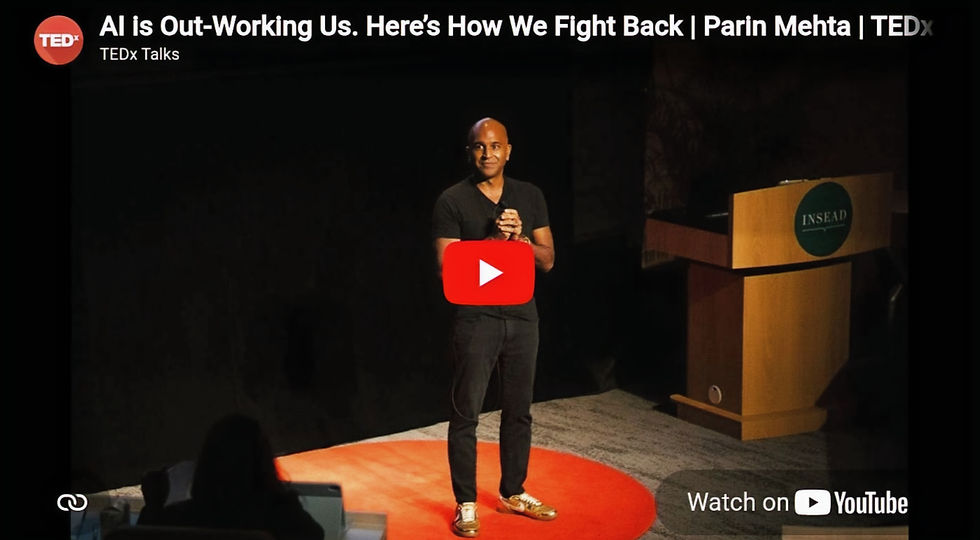
Watch his Ted Talk sharing here. "Exceptional operators love getting their hands dirty," he notes. "When they join a board, their natural reflex is to critique the marketing copy or redesign the sales funnel."
Good governance, he argues, is about altitude. It’s about ensuring the leadership team has the necessary resources and that the organization is protected from blind spots. The shift requires moving from direct orders to strategic inquiry—asking the uncomfortable, thoughtful questions that an executive team, buried in the weeds, might miss.Backing the "Whole Human Being"
Perhaps the most significant evolution in Parin’s philosophy is his view on venture capital. Early in his career, he bought into the myth that success is defined by who can grind the hardest. Years spent supporting early-stage founders at Liminal cured him of that perspective.
"A company will never be healthier or more resilient than the founder running it," Parin asserts. When founders burn out, strategic thinking narrows Today, he views stamina, emotional clarity, and a life outside of work—family, exercise, and fun—not as "lifestyle perks," but as foundational business requirements. He now positions himself for "10-year games" rather than the two-year burn cycles that characterize so many failed ventures.Entering Parin 3.0: The Artist

This journey led Parin to the Distinguished Senior Fellow Program (DSFP) at NUS. Having reached the pinnacle of tech, he realized he had fallen into a comfortable, echo-chamber bubble. He wanted a reboot. Immersing himself in Eastern philosophy, somatic therapy, and diverse perspectives from government and civil society, he discovered a new language for his evolution: moving from "The Grinder" to "The Artist."
"The Grinder works out of anxiety and accumulation, constantly pushing uphill," Parin explains. "The Artist works with presence, simplicity, and flow."
Today, his definition of success is no longer about a packed calendar. It’s about doing fewer things, doing them with deep focus, and keeping life grounded. As he maps out "Parin 3.0," the goal is simple: to help ambitious founders and executives realise they don't have to "burn their life down" to build something meaningful.
"We can create immense impact while still having dinner with our family," he says. That, for Parin, is the ultimate legacy—building world-class companies with clarity, joy, and the peace of mind to rest well when the day is done. ----- Parin is an investor and executive coach. You can find more of his work at coachparin.com or watch his recent thoughts on his TEDx talk.


Comments